Learn 2 Mix
Welcome to the download page for "Learn 2 Mix" by Digital Multi Soft Corp, a cutting-edge software designed to revolutionize your mixing experience on Windows 10. ...

jVLT is an open-source vocabulary tutor for building word lists and reviewing them with flash-card quizzes based on a selective learning system similar to the Leitner method. Entries can include example sentences that show how words are used, and quizzes display those examples during review. The program also supports complex searches, printing selected vocabulary, and importing words and examples from CSV files. Its zipped XML storage format makes data easier to convert for other uses.
| Author: | Henning Burchardt |
| License: | Open Source |
| Price: | FREE |
| Released: | Dec 22, 2013 |
| File size: | 4.60 MB |
| Downloads: | 297 |
| Keywords: | leitner flashcard system, vocabulary learn, import vocabulary csv, open-source software, vocabulary list manager, vocabulary, vocabulary learning tool, Windows 10 compatible, language learning, jVLT, vocabulary tutor, language trainer, language vocabulary tutor, learn, Henning Burchardt, flashcard vocabulary quiz, dictionary |
| Author URL: | http://jvlt.sourceforge.net/ |
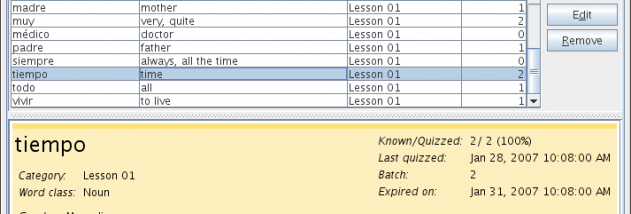

jVLT is an open-source vocabulary learning tool for language learners who want to build and review a personal word collection. Each entry can include examples containing one or more vocabulary words, helping learners connect a word with how it appears in context rather than studying an isolated translation or definition. The collection can be organized as a reusable study resource and used for repeated practice.
For review, jVLT provides flash-card quizzes based on a selective learning system similar to the Leitner method. During a quiz, it displays examples associated with each word, so learners can recall vocabulary while seeing its usage. The flash-card format supports regular practice, while the selective review approach helps focus study on words that need further attention.
The program includes search tools for finding entries and filtering the collection. Searches can combine conditions, including whether a word appeared in a quiz within a specified recent period. Vocabulary lists, or selected portions of them, can be printed for offline reference. CSV import provides a way to bring in words and examples from spreadsheet or other tabular data, reducing the need to enter an existing collection again by hand.
jVLT stores vocabulary data in zipped XML. This format makes the collection accessible for conversion to other formats, such as material for a web page, and offers a practical option for users who want to work with their data beyond the program. Together, examples, searches, quizzes, printing and import support a workflow that can begin with building a word list and continue through review and reuse.
Written in Java, jVLT can run on multiple platforms, including Windows, Linux and macOS, with a suitable Java environment. It is open source and intended for vocabulary study rather than general-purpose translation or dictionary lookup. Windows users should check that Java is available on their system before running the program.