Numpy for Windows
NumPy is an open-source library for Python that provides core tools for numerical and scientific computing. It is used by Python developers, researchers, engineers and analysts who need to ...

NumPy is an open-source Python library for working with numerical data. Its multidimensional ndarray stores values of a consistent type and supports fast, element-wise calculations, slicing, reshaping and broadcasting. The library also includes tools for linear algebra, Fourier transforms, statistics, sorting and random-number generation. It is commonly used in scientific computing, data analysis and simulations, and provides an array foundation for many other Python packages.
| Author: | Jarrod Millman |
| License: | Open Source |
| Price: | FREE |
| Released: | Oct 12, 2026 |
| File size: | 5.90 MB |
| Downloads: | 33 |
| Keywords: | Matrix, Numpy (Numerical Python), numpy library, download Numpy (Numerical Python), Numerical, numpy matrix operations, python scientific computing, Python, numpy linear algebra, python array library, Numpy (Numerical Python) free download, Python Component, python numerical computing, Math for Python, Python Array, Numarray |
| Author URL: | http://www.numpy.org/ |
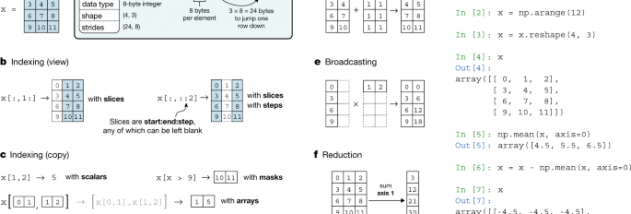
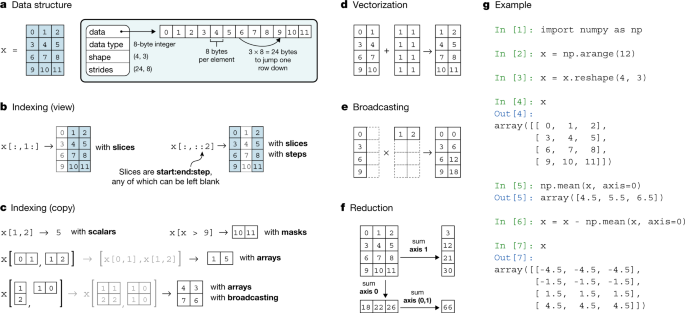


NumPy, short for Numerical Python, is an open-source library for Python programmers working with numerical data. Its central array type, ndarray, stores elements of a consistent data type in a fixed-size, multidimensional structure. This design provides a practical foundation for representing vectors, tables and higher-dimensional data, and for performing calculations on them without writing a separate Python loop for every element. It is used in scientific computing, engineering, statistics, data analysis and other tasks that involve substantial numerical work.
NumPy arrays support element-wise arithmetic and mathematical functions, allowing operations to be applied across entire arrays. Broadcasting lets compatible arrays with different shapes participate in a calculation without first copying values into matching dimensions. Indexing and slicing select particular elements, rows, columns or ranges, while reshaping changes an array's dimensions for a different stage of processing. These tools help developers express common calculations compactly and work with large collections of values more conveniently than with ordinary Python lists.
The library also provides routines for common numerical tasks. Its linear algebra tools work with matrices and vectors, including operations such as solving systems and finding eigenvalues or eigenvectors. The Fourier transform functions support conversions between data represented in different domains, while statistical and aggregation operations can calculate summaries across chosen dimensions. Sorting, searching and random-number generation are also available, making NumPy useful for preparing data, running simulations and building computational workflows.
NumPy often serves as a base layer for other Python packages. A developer can use it to hold and transform data, then pass arrays to libraries for plotting, scientific algorithms or machine learning. In practice, this can mean loading measurements into arrays, filtering or combining them, calculating summaries and supplying the results to another tool. It is suited to both interactive exploration and reusable scripts, though it is a programming library rather than a standalone graphical analysis application.
NumPy is open source and may be used in commercial projects; its source code can also be modified under the terms of its license. The supplied Windows package is intended for Windows 10 and Windows 11, including 32-bit and 64-bit systems. Using the library requires a Python environment, and the specific Python compatibility depends on the NumPy package build being installed. It is commonly installed as part of a Python-based development setup and imported into scripts or interactive sessions when numerical array operations are needed.