Model ChemLab
Welcome to the download page for Model ChemLab, an innovative software developed by Model Science Software. This interactive tool is designed to simulate a real-world chemistry ...

RasMol is an open-source molecular graphics viewer for proteins, nucleic acids and small molecules. It opens coordinate files and displays structures interactively using wireframes, Dreiding sticks, space-filling spheres, ball-and-stick models, ribbons, labels and dot surfaces. Colour schemes help distinguish parts of a molecule, while multiple input formats support scientific, teaching and image-preparation workflows.
| Author: | Roger Sayle |
| License: | Open Source |
| Price: | FREE |
| Released: | Jul 22, 2009 |
| File size: | 922 kB |
| Downloads: | 429 |
| Keywords: | chemistry, open source molecular viewer, molecular graphics visualization, open-source software, protein structure viewer, molecular coordinate files, RasMol, molecule visualization, molecular graphics viewer, Windows 10 application, molecule, protein molecule, x64 software, Roger Sayle, molecular modelling, chemistry teaching software, chemical |
| Author URL: | http://www.openrasmol.org/ |
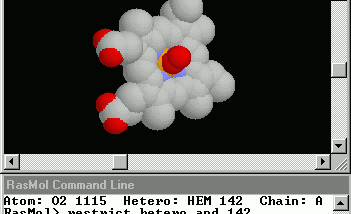

RasMol is an open-source molecular graphics viewer for exploring proteins, nucleic acids and small molecules. It is intended for scientists, students and educators who need to inspect molecular structures, explain their shapes and relationships, or create images for scientific publications. Rather than presenting a molecule as a static diagram, RasMol lets users interactively view its three-dimensional structure and change how its atoms and bonds are drawn.
The program opens molecular coordinate files and displays their contents using a choice of representations and colour schemes. Wireframe views show bonds while retaining a sense of depth; Dreiding sticks and ball-and-stick styles make connections between atoms easier to follow. Space-filling CPK spheres emphasize the volume occupied by atoms. These alternatives let users shift between examining molecular connections and getting an overall impression of a structure. Colour schemes and atom labels provide further ways to distinguish parts of a molecule.
For biomolecules, RasMol can render solid or strand ribbons, offering a more readable view of protein and nucleic-acid structure than an atom-by-atom display. Dot surfaces provide another way to examine molecular shape. Users can switch representations to suit the structure and the point they want to communicate, whether that means studying local detail or preparing a clear visual for teaching or publication. The interactive display makes these views useful for exploration as well as image preparation.
RasMol reads several common molecular file types, including Protein Data Bank (PDB), Tripos Alchemy and Mol2, MDL Mol, XYZ (XMol), CHARMm, CIF and mmCIF files. This format range supports work with structures from different molecular modelling and data sources. Its graphics are used in teaching, molecular visualization and the preparation of publication-quality images. As open-source software, RasMol also makes its source code available for inspection and adaptation, which can be valuable in research settings where users need to understand or modify their scientific tools.
RasMol is free and open source. Windows versions are listed for Windows XP, Vista, 7, 8 and 10; the program also has versions for other operating systems. Some optional features mentioned for its X Window System version, such as hardware dial controls and accelerated shared-memory communication, depend on support in the system's X server and do not describe the Windows build. The application is a focused molecular viewer rather than a general-purpose chemistry suite: its central role is to display and render structures supplied in molecular coordinate files.