Windows Live Essentials 2012
Windows Live Essentials 2012 is a collection of Microsoft ... and file access. The suite was intended for Windows users who wanted several everyday tools in one ...

AstroGrav is a celestial mechanics simulator for building and exploring systems of stars, planets, moons, spacecraft and other objects. It lets users enter physical and orbital properties, then watch how gravity moves objects over time. Sample simulations, adjustable time steps, Newtonian and General Relativity-based calculations, and interactive viewing tools support astronomy study and experimentation.
| Author: | AstroGrav |
| License: | Freeware |
| Price: | FREE |
| Released: | Oct 10, 2026 |
| File size: | 25.10 MB |
| Downloads: | 44 |
| Keywords: | Simulation, Planet Simulation, celestial mechanics, Space Simulation, freeware, gravity simulator, Newtonian and General Relati, celestial mechanics software, download AstroGrav, Windows, Orbit, astronomy simulation, Planet, planet orbit simulator, space simulation, orbital motion simulator, Astronomy, AstroGrav, space simulation software, Gravity Simulator, AstroGrav free download |
| Author URL: | http://www.astrograv.co.uk/support2.html |

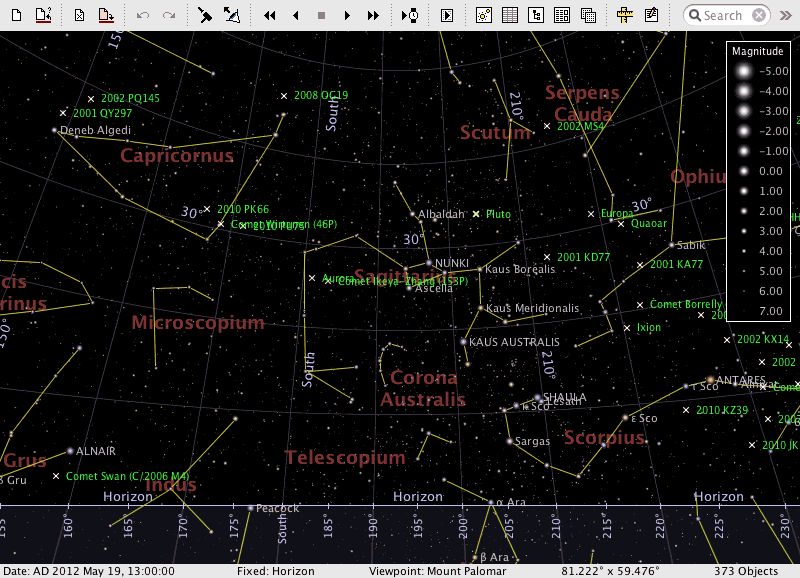
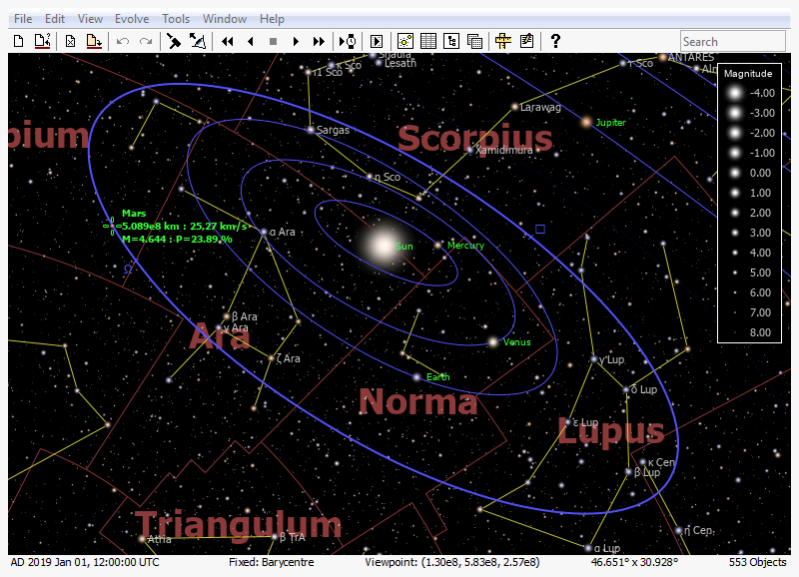
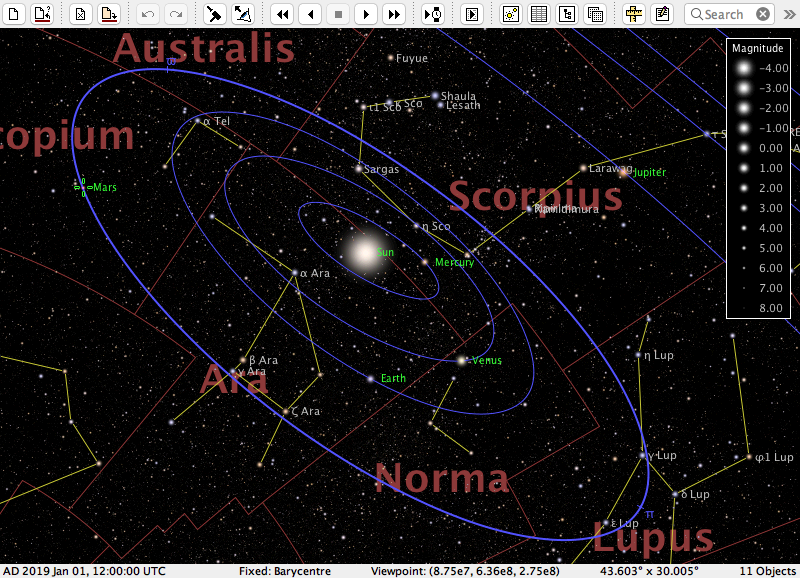

AstroGrav is a celestial mechanics simulator for exploring how stars, planets, moons, spacecraft and other objects move under gravity. It is suited to astronomy students, educators and hobbyists who want to build or inspect orbital scenarios rather than view a conventional sky map. Simulations show the changing positions of their objects over time, making it possible to examine trajectories and experiment with different physical and orbital parameters.
The program includes sample simulations that can be opened as starting points for exploration or editing. To create a custom scenario, users organize objects into families and enter properties such as mass, radius and luminosity alongside orbital elements including eccentricity and inclination. Object types include stars, planets, moons, spacecraft and projectiles. These values determine the simulated system, so changing an object's properties provides a way to compare how different setups affect its motion.
Simulation controls advance the model through time, with configurable time steps ranging from seconds to years. AstroGrav can calculate motion using either Newtonian gravity or a General Relativity-based algorithm. This makes it possible to investigate the same system under different calculation approaches, or to choose a time scale that fits the scenario being studied. The workspace supports mouse and keyboard navigation, including panning, rotating and zooming, while display options can add details, grids and axes. A parallax view is also available for use with 3D glasses.
The interface keeps the simulation view prominent and places menus and toolboxes in separate floating panels that can be arranged around the workspace. A toolbar provides access to simulation controls and view options. Beginners can use the included examples to learn how objects and settings work; more experienced users can modify those examples or construct systems from their own object data. The resulting simulations can support classroom demonstrations, personal astronomy projects and experiments with orbital motion.
AstroGrav is freeware for Windows, including 64-bit Windows 10 and Windows 11. It also supports 64-bit Windows 7 and Windows 8. Java Runtime Environment must be installed to run the program. Its object editor asks for detailed physical and orbital inputs, so preparing realistic simulations requires some familiarity with the quantities involved.