Praat
Praat is a speech analysis, synthesis, and editing program for linguists, phoneticians, speech scientists, and others working with spoken language. It turns recorded speech into ...

Praat is a scientific tool for phonetic speech analysis, synthesis and manipulation. It visualizes audio with spectrograms and provides pitch, formant, intensity, jitter, shimmer and voice-break analysis. Researchers can annotate recordings on multiple tiers, alter pitch and duration, run listening experiments, and synthesize speech. Scripting, statistical tools and export to formats such as WAV and FLAC support research workflows.
| Author: | Paul Boersma and David Weenink |
| License: | Freeware |
| Price: | FREE |
| Released: | Jun 11, 2024 |
| File size: | 12.90 MB |
| Downloads: | 435 |
| Keywords: | x64 speech synthesis, Acoustic data processing, Phonetic research, audio annotation tool, x64 synthesize, x64 create picture, Sound manipulation, Linguistic software, Audio visualization, Speech analysis, phonetics research software, x64 synthesize speech, speech synthesis software, x64 analyze speech, x64 analyze, spectrogram and pitch analysis, x64 speech, phonetic analysis tool, x64 manipulate, speech analysis software |
| Author URL: | https://www.fon.hum.uva.nl/praat/ |
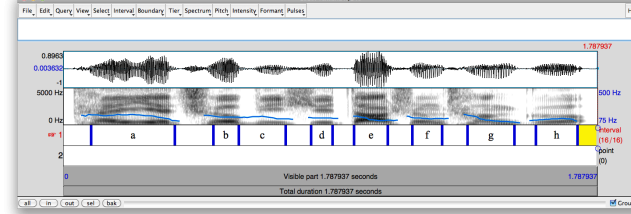

Praat is a scientific application for phonetic speech analysis, synthesis and manipulation. Developed by Paul Boersma and David Weenink, it is intended for linguists, phonetics researchers, speech scientists and students working with recorded or synthesized speech. Its analysis tools turn audio into visual and numerical information, helping users examine how speech sounds are produced and how their acoustic properties change over time. The interface and documentation suit users who are comfortable working with sound signals and technical measurements.
The program displays speech through spectrograms and other visual analyses, including pitch, formants and intensity. These views help identify frequency patterns, track fundamental frequency, inspect resonances and measure changes in loudness. Praat can also examine voice quality through jitter, shimmer and voice-break measurements, and provides cochleagrams and excitation patterns for additional auditory and acoustic investigation. Users can label intervals and time points on multiple annotation tiers, making it possible to align phonetic transcription or other notes with specific parts of a recording. Phonetic symbols are available for annotation.
For working with sound, Praat can alter pitch and duration contours, apply filtering, and synthesize speech from pitch, formant and intensity information. It also supports articulatory synthesis, which models speech production through articulation. Researchers can build listening experiments such as identification and discrimination tests, and use learning and statistical tools including feedforward neural networks, Optimality Theory, multidimensional scaling, principal component analysis and discriminant analysis. Audio can be imported and exported in several formats, including WAV, AIFF, AIFC, NIST and FLAC, as well as raw audio data.
Praat supports scripting for repeatable analyses and can communicate with other programs, helping automate tasks or integrate its tools into a research workflow. Its graphics tools produce publication-quality figures and Encapsulated PostScript output, with mathematical and phonetic symbols available for scientific documents. Users can adjust menus and save preferences for fonts, views and audio devices. The program can work with large recordings, and its machine-independent data files help preserve work across systems.
Praat is freeware for 64-bit Windows, with the supplied operating-system information covering Windows Vista, Windows 7, Windows 8, Windows 10 and Windows 11. Its detailed documentation supports learning the analysis and scripting tools. The combination of measurement, annotation, synthesis and statistical functions makes it useful for coursework, laboratory research, speech technology and the preparation of figures or transcriptions for academic work.