Praat x64
Praat is a scientific application for phonetic speech analysis, ... frequency, inspect resonances and measure changes in loudness. Praat can also examine voice quality through jitter, shimmer ...

Praat is an open-source program for analyzing, synthesizing, and editing speech. It displays recordings as waveforms and spectrograms and measures properties including pitch, formants, intensity, jitter, and shimmer. Multiple annotation tiers support aligned transcription and segmentation, while editing tools can change pitch, duration, and formants. Scripting helps automate repetitive analyses. It is used in phonetics, linguistics, speech analysis, and language teaching.
| Author: | Paul Boersma/David Weenink |
| License: | Open Source |
| Price: | FREE |
| Released: | May 21, 2026 |
| File size: | 22.30 MB |
| Downloads: | 570 |
| Keywords: | synthesize, praat speech analysis, speech analysis tool, speech annotation software, phonetic research, audio manipulation, phonetic analysis software, synthesize speech, analyze speech, acoustic analysis tool, speech, speech spectrogram tool, Praat software, analyze, create picture, speech synthesis program, linguistic studies, Paul Boersma and David Weenink |
| Author URL: | https://www.fon.hum.uva.nl/praat/ |

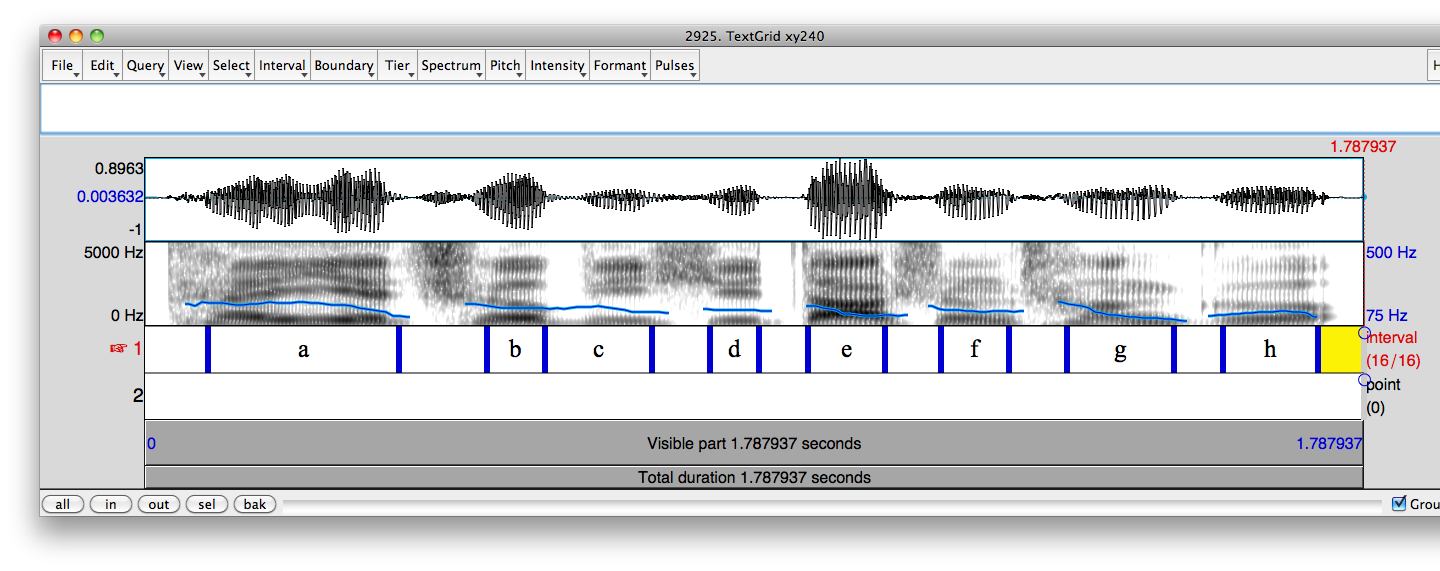



Praat is a speech analysis, synthesis, and editing program for linguists, phoneticians, speech scientists, and others working with spoken language. It turns recorded speech into visual and measurable data, helping users examine how sounds are produced and compare differences between speakers, words, or recording conditions. Its tools range from straightforward waveform inspection to detailed acoustic measurements and scripted research workflows.
Users can view speech as waveforms and spectrograms, then inspect pitch, formants, intensity, and measures such as jitter and shimmer. These displays help locate sound boundaries and study properties such as voicing, resonance, loudness, and vocal-period variation. Praat also supports labeling and segmenting recordings with multiple annotation tiers, so transcripts and phonetic notes can be aligned with specific portions of audio. This is useful when building consistent annotations for individual recordings or larger datasets.
The program can synthesize speech sounds and manipulate existing material, including changes to pitch, duration, and formant frequencies. Researchers can use these functions to prepare stimuli or test questions about speech production and perception. Praat's scripting language automates repeated measurements and processing steps, which is particularly useful when a study involves many files or a consistent analysis procedure. Visual outputs also help users review results and prepare speech data for teaching or presentations.
Typical uses include phonetic and phonological research, speech-language analysis, language teaching, and forensic examination of speech. In a classroom, a teacher can use acoustic displays to show learners how pronunciation differs from a target; in research, annotations and measurements can support comparisons across sounds or speakers. Results depend on the quality and consistency of the recordings, and acoustic measurements generally require interpretation within the relevant linguistic or experimental context.
Praat is open-source software developed by Paul Boersma and David Weenink. The Windows download supports Windows 10 and Windows 11, with both 32-bit and 64-bit compatibility stated for Windows 10; Windows 7 and 8 are also included in the supplied operating-system information. The program is also available for macOS and Linux. Its broad range of tools suits both occasional inspection and more structured analysis, though users may need to consult documentation to make effective use of advanced measurements and scripting.