ShapeBook with 2D3DSteel
... the renowned South Fork Technologies, Inc. This powerful Windows 10 compatible software is a versatile tool for professionals in the steel industry, offering a comprehensive ...

LigandScout is a molecular modeling and virtual screening application for researchers working with ligands and protein binding sites. It creates 3D pharmacophore models from ligand- or structure-based workflows, aligns molecules in bioactive conformations and screens compound collections against models. Linked 3D, 2D and hierarchical views support structure inspection, while ROC curves and enrichment-factor calculations help assess screening results. Models can be exported to Catalyst, MOE and Phase.
| Author: | Ligand |
| License: | Trialware |
| Price: | FREE |
| Released: | Dec 13, 2013 |
| File size: | 181.00 MB |
| Downloads: | 372 |
| Keywords: | molecular screening analysis, Pharmacophore export, virtual screening tool, Pharmacophore Modeling, ligand-based modeling, chemical model, molecular modeling, 3d pharmacophore design, drug discovery, 3D chemical model, Windows 10 compatible, LigandScout, Ligand, Pharmacophore, pharmacophore modeling, pharmacophore modeling software, molecule, structure-based pharmacophore |
| Author URL: | http://www.inteligand.com/ |
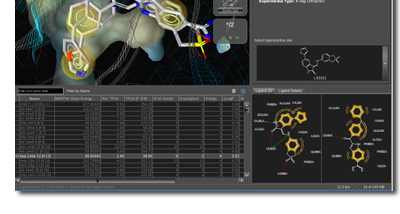

LigandScout is a molecular modeling and virtual screening application for researchers working with ligand structures and protein binding sites. It helps users build three-dimensional pharmacophore models: representations of the chemical features and spatial relationships that contribute to molecular recognition. Models can be created from ligands or from structures, then used to search for compounds with matching features.
For structure-based work, LigandScout interprets ligands in PDB structures using geometry, dictionaries and rules, and lets users inspect or correct the perceived ligand in the binding site. Its linked 3D, 2D and hierarchical views help relate a molecule's spatial arrangement to its chemical features. Users can account for cofactors, ions, water molecules and covalent ligands, choosing whether relevant components belong to the ligand or the macromolecule. Molecules can be aligned in bioactive conformations against other molecules or pharmacophores, supporting comparison of binding modes and identification of shared features.
Ligand-based modeling classifies chemical features, assigns feature weights and can add exclusion-volume spheres to represent regions that should remain unoccupied. Pharmacophore-based clustering can help select training sets. Tautomer enumeration and molecular geometry generation using the MMFF94 force field support preparation of structures for modeling and screening. File and repository tools organize binding sites, molecules and pharmacophores, while support for common chemical formats and export to Catalyst, MOE and Phase helps transfer models to other screening workflows.
The screening tools search compound collections against pharmacophore models and provide analysis for assessing results. ROC curves and enrichment-factor calculations help measure screening performance. Boolean combinations of target and anti-target models can define criteria that favor compounds matching a desired target while rejecting matches to an unwanted one. These functions are useful for building and evaluating virtual screening workflows, comparing candidate molecules and studying the features associated with a binding mode.
LigandScout is trialware intended for molecular modeling and computational chemistry work. Its graphical interface includes advanced 3D graphics, undo support and adjustable parameters for users who need more control over modeling. The supplied platform information lists Windows releases through Windows 8; it does not establish compatibility with Windows 10 or Windows 11. The application is designed for working with molecular structures and pharmacophore models rather than general-purpose document editing.