Build a Molecule
... you can discover the innovative software "Build a Molecule" developed by the University of Colorado. This cutting-edge program allows users to explore the world of chemistry in a fun and interactive way. With "Build a ...

Molecule Shapes is an interactive chemistry simulation from the University of Colorado's PhET project. Users build molecules by adding atoms, then observe how their three-dimensional arrangements and bond angles change. The simulation illustrates VSEPR theory by showing how bonding pairs and lone pairs influence molecular geometry. Preset molecules offer examples for classroom demonstrations or self-study, while adjustable atom and electron-pair counts encourage experimentation. It is an open-source learning tool for students and educators exploring molecular shape.
| Author: | University of Colorado |
| License: | Open Source |
| Price: | FREE |
| Released: | Mar 28, 2026 |
| File size: | 2.50 MB |
| Downloads: | 196 |
| Keywords: | download Molecule Shapes, University of Colorado, interactive, molecule, molecule builder, builder, education, vsepr theory simulation, interactive simulation, molecular geometry, build, chemistry learning software, simulation, shape, Molecule Shapes free download, user-friendly interface, Molecule Shapes, build molecule, molecular geometry tool, molecule shape, chemistry, molecule shapes, molecule shapes simulation, visual modeling, chemistry learning, educational tool, 3d molecule shapes |
| Author URL: | https://phet.colorado.edu/ |

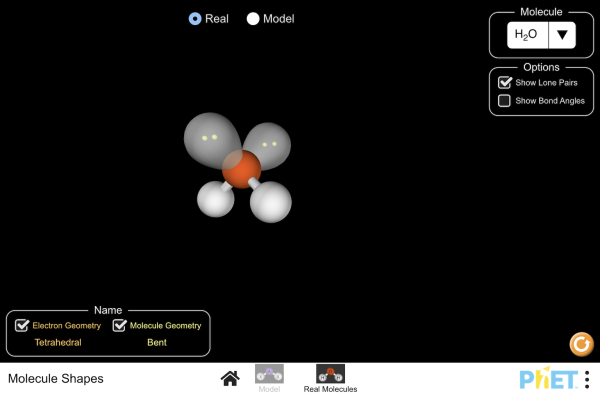


Molecule Shapes is an interactive chemistry simulation from the University of Colorado's PhET project. It is intended for students and educators studying molecular geometry, including learners who need a visual way to connect a molecule's arrangement of atoms and electron pairs with its three-dimensional shape. Rather than presenting geometry only through diagrams or equations, the simulation lets users construct molecules and observe how their structures respond as they change the model.
Users add atoms to build a molecule and examine its spatial arrangement in real time. Changing the number or placement of atoms makes it possible to compare molecular structures and see how the geometry shifts. The visual feedback helps make features such as bond angles easier to understand: learners can relate a molecule's shape to the positions of its bonds instead of relying solely on a flat representation. The hands-on approach also supports trying different arrangements and checking the resulting shape as the model is adjusted.
The simulation explores VSEPR theory, which explains molecular geometry through repulsion between electron pairs. Users can investigate how bonding pairs and lone pairs affect the arrangement around a central atom, and how those interactions influence the overall molecular shape. By changing the number of atoms and electron pairs, learners can compare configurations and test their understanding of the relationship between electron-pair repulsion, bond angles and geometry. Preset molecules provide ready-made examples for examining familiar structures without first building each one from scratch.
Molecule Shapes can support classroom demonstrations, chemistry lessons and independent study. An educator can use its visual models to introduce or reinforce molecular geometry, while students can explore examples at their own pace and compare how different electron-pair arrangements affect shape. Its interactive format is useful when a concept is difficult to picture from a two-dimensional textbook drawing, and experimentation gives learners a way to test predictions rather than simply memorize names of shapes.
The program is open source and is available for Windows 10 and Windows 11, as well as older Windows releases. The simulation's straightforward, drag-and-drop interface is designed for learners at different levels, from secondary-school chemistry through undergraduate study. It focuses on exploring molecular shapes and VSEPR concepts, making it a compact educational tool rather than a general-purpose molecular modeling or chemistry research application.